Guides · Checked 29 October 2026
FOB price: what it includes and how to quote it
An FOB price is the seller's price for goods delivered on board the vessel the buyer has nominated, at a named port of shipment. Under the Incoterms® 2020 FOB rule it covers the goods, export packing and marking, transport to the port, export clearance and loading on board. Ocean freight, insurance, destination charges and import duties are left to the buyer, because risk and cost pass to the buyer once the goods are on board.
What FOB means under Incoterms® 2020
FOB (Free on Board) is one of four Incoterms® 2020 rules for sea and inland-waterway transport only, always followed by a named port of shipment. Under the ICC rule:
- The seller delivers by placing the goods on board the vessel the buyer has nominated at that port. Procuring goods already shipped that way also counts, which suits commodity string sales.
- Risk and costs pass to the buyer once the goods are on board.
- The buyer contracts and pays for carriage from the port of shipment. The seller has no duty to book the ship.
- The seller clears the goods for export. Import clearance, transit formalities and import duties belong to the buyer.
- Neither party owes the other an insurance policy. If the buyer asks, the seller must pass on information the buyer needs to insure the goods.
ICC Academy adds that if the buyer gives late vessel notice, or the ship arrives late or closes early, risk and extra costs can shift to the buyer before anything is loaded.
Costs inside an FOB price
The seller bears every cost up to delivery on board. In practice an FOB quotation should cover:
- The goods, at cost plus margin.
- Packing and marking for export. Under the FOB rule the seller packages and marks goods suitably for their transport, unless the trade usually ships them unpackaged or the contract sets other packing terms. See our guide to shipping marks.
- Inland haulage to the port. ICC Academy confirms that the seller pays to move the goods to the port and to load them.
- Export clearance and any export duties, together with checks the seller needs in order to deliver.
- Proof of delivery. The seller provides the usual proof that the goods were delivered, at its own cost.
- Origin port and terminal charges up to loading. Costs before delivery are the seller's, but ICC's notes to the FAS rule warn that port handling costs vary with port practice, so name each charge in the contract. A 2024 Genoa Chamber of Commerce note links FOB on containers to terminal handling charges (THC) billed twice, and to disputes.
What an FOB price leaves out
- Ocean freight and any other carriage from the port of shipment.
- Cargo insurance, which the buyer arranges if it wants cover.
- Charges at the destination port, plus unloading and delivery to the buyer's premises.
- Import clearance, import duties and taxes, and any transit formalities.
If the buyer wants a price that includes main carriage, use a rule in which the seller contracts for it. For containers, the Genoa Chamber's summary of ICC guidance points to CPT or CIP at the destination port. The Incoterms® 2020 chart shows how costs are split under each rule.
Worked example: from ex-works cost to an FOB quote
Illustrative figures only. They are not market rates. A factory near Ningbo sells 1,000 ceramic mugs. Its ex-works cost is USD 3.40 per mug, and it packs 20 mugs to a carton.
| Cost line | Calculation | USD |
|---|---|---|
| Goods, ex-works | 1,000 × 3.40 | 3,400.00 |
| Export cartons and marking | 50 cartons × 0.90 | 45.00 |
| Haulage, factory to Ningbo port | quoted lump sum | 240.00 |
| Export customs declaration | quoted lump sum | 40.00 |
| Origin port charges agreed as seller's | quoted lump sum | 115.00 |
| Cost delivered on board | sum of the above | 3,840.00 |
| Markup 12.5% | 3,840.00 × 0.125 | 480.00 |
| FOB total | 3,840.00 + 480.00 | 4,320.00 |
| FOB unit price | 4,320.00 ÷ 1,000 | 4.32 |
The quotation line reads "USD 4.32 per pc FOB Ningbo, Incoterms® 2020"; the buyer adds freight, insurance and import costs. If you are unsure the goods fit the buyer's booking, estimate the shipment volume before you quote.
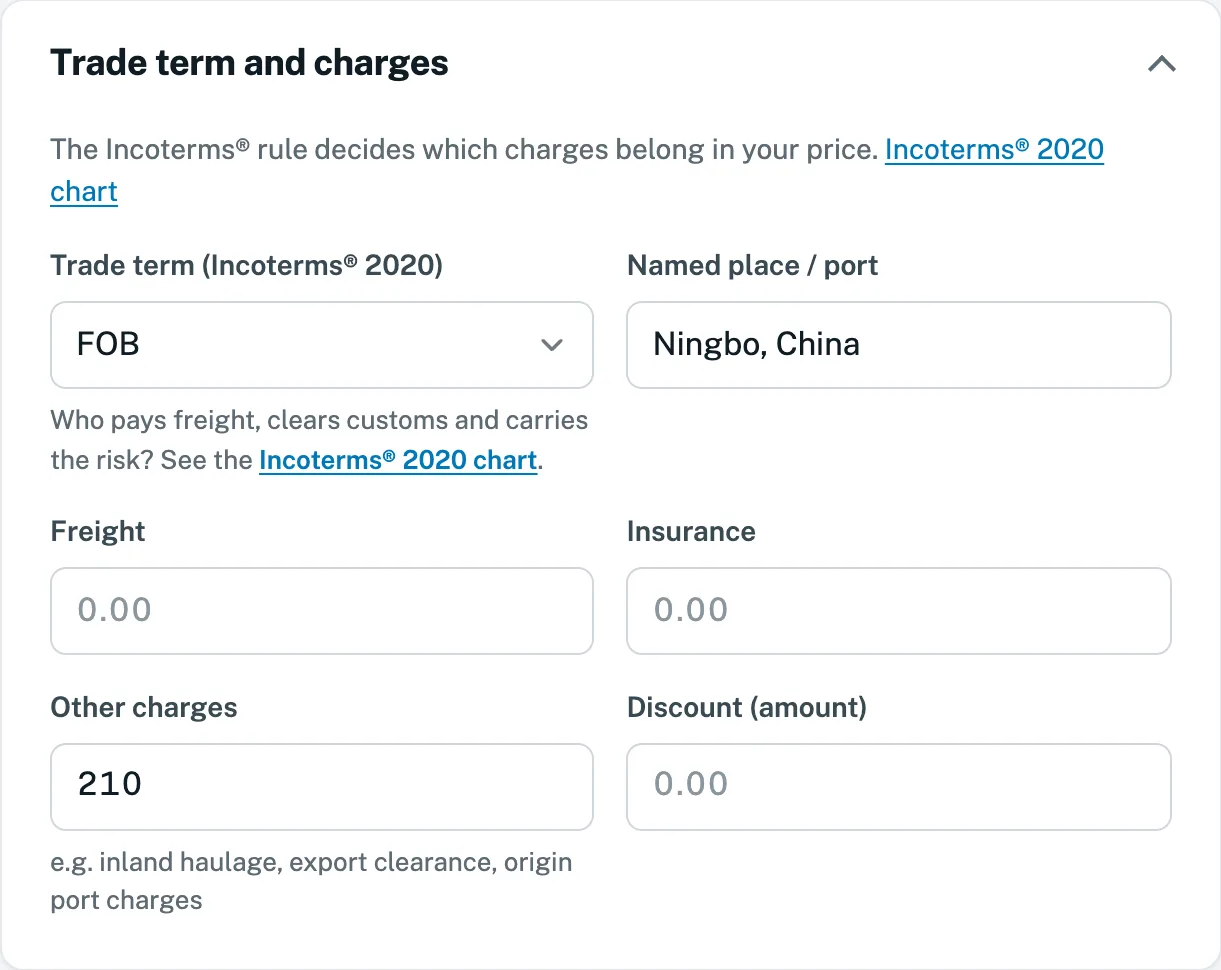
How to write FOB on a quotation
- Name the port of shipment. The rule's format is FOB followed by the named port of shipment, for example "FOB Ningbo". "FOB China" and "FOB factory" do not name a port.
- State the version. The U.S. International Trade Administration notes that older editions can still be agreed, so name the version on the contract and documents: "FOB Ningbo, Incoterms® 2020".
- Use the same term on every document. In Quotepad the quotation, pro forma invoice, commercial invoice and packing list come from one record, so term and port are typed once.
- List origin charges you include where port practice leaves doubt.
FOB or FCA for container shipments?
ICC's explanatory note to the FOB rule says FOB does not fit cases where goods are handed to the carrier before they are loaded, such as at a container terminal. There, FCA should be considered. In the ICC Academy article comparing the two rules, "FOB is to be used only for maritime or inland waterway transportation". The same article calls FCA the appropriate rule for goods moving in containers or on pallets.
ICC Academy notes that a containerised seller typically delivers to the container terminal, not onto the ship. Under FOB the seller would still carry the risk until loading; under FCA delivery happens at handover. ICC's March 2024 guidance note on FCA and CPT for containers responds to a 2023 survey that found the chosen rule often does not match port reality. If a letter of credit calls for an on-board bill of lading, Incoterms® 2020 FCA lets the buyer instruct its carrier to issue one to the seller. See FOB and FCA on the chart.
"FOB" in US domestic sales is different
In US domestic contracts, "F.O.B." can carry its Uniform Commercial Code meaning instead of the Incoterms® one. Under UCC § 2-319, "FOB place of shipment" means the seller bears cost and risk until the goods are in the carrier's possession. "FOB place of destination" means the seller carries them to the named destination at its own cost and risk. On export quotations, name Incoterms® 2020 to avoid that reading.
Frequently asked questions
What does FOB price mean?
The price for goods loaded on board the buyer's nominated vessel at a named port of shipment, including export packing, transport to the port and export clearance. Freight, insurance and import costs are excluded.
When does risk pass to the buyer under FOB?
Once the goods are on board at the named port of shipment. It can pass earlier if the buyer fails to give vessel notice or the ship is late.
Does an FOB price include ocean freight or insurance?
No. The buyer pays carriage from the port of shipment. Neither party must insure for the other; the seller only supplies information the buyer needs to insure.
Who pays terminal handling charges under FOB?
Costs before loading are the seller's and costs after are the buyer's, but billing follows port practice. State which origin charges your FOB price includes.
Should I use FOB for container shipments?
ICC advises considering FCA when goods are handed over at a container terminal before loading. FOB fits goods loaded directly onto the vessel, such as bulk cargo.
Is FOB shipping point the same as FOB under Incoterms?
No. FOB shipping point and FOB destination are US domestic terms under UCC § 2-319. On export quotations write the port and version, for example FOB Ningbo, Incoterms® 2020.
Related guides: Pro forma vs commercial invoice · Shipping marks · All guides
Sources
- International Chamber of Commerce, "Incoterms® 2020: Rules for Sea and Inland Waterway Transport" (ICC Digital Library), library.iccwbo.org/content/tfb/BOOKS/BK_0049/BK_0049_05_RulesSea.htm (opened 29 October 2026).
- ICC Academy, "Incoterms® 2020: FCA or FOB?", academy.iccwbo.org/incoterms/article/incoterms-2020-fca-or-fob/ (opened 29 October 2026).
- ICC Academy, "Incoterms® 2020: FAS or FOB?", academy.iccwbo.org/incoterms/article/incoterms-2020-fas-or-fob/ (opened 29 October 2026).
- International Chamber of Commerce, "Incoterms® 2020", iccwbo.org/business-solutions/incoterms-rules/incoterms-2020/ (opened 29 October 2026).
- ICC Knowledge 2 Go, "INCOTERMS® 2020 FCA and CPT: Best practice for shipping containers through ports", 2go.iccwbo.org/incotermsr-2020-fca-and-cpt-best-practice-for-shipping-containers-through-ports.html (opened 29 October 2026).
- Camera di Commercio di Genova, Ufficio Commercio Estero, "Best practice per la spedizione dei container via mare: termini di resa ICC Incoterms® da utilizzare" (8 February 2024), ge.camcom.gov.it/…/termini-di-resa-icc-incoterms-da-utilizzare.pdf (opened 29 October 2026).
- U.S. International Trade Administration, "Know Your Incoterms", trade.gov/know-your-incoterms (opened 29 October 2026).
- Legal Information Institute, Cornell Law School, "U.C.C. § 2-319. F.O.B. and F.A.S. Terms", law.cornell.edu/ucc/2/2-319 (opened 29 October 2026).
This guide is general information, not legal or customs advice. For a specific shipment, check the terms with your buyer's freight forwarder or a customs broker. Incoterms® is a registered trademark of the International Chamber of Commerce.