Guides · Checked 29 October 2026
Packing slip vs packing list: what each document is for
A packing slip is the seller's list of what is in an order, sent with the parcel so the recipient can check the items; it belongs to domestic and e-commerce shipping and is not an invoice. An export packing list does a heavier job: it itemises the contents of each package, with weights and measurements, so freight forwarders can work out freight costs and customs officials can check a specific carton. Neither replaces the commercial invoice, and neither is a bill of lading, which is the contract between the owner of the goods and the carrier.
What a packing slip is
In e-commerce, a packing slip is a printable document included with an order. Shopify's help centre says it lists the items with shipping and billing addresses, SKUs and quantities; warehouse staff use it to pick and pack, and the customer gets a record of what was sent.
Etsy describes packing slips as a record of the transaction for buyers, meant to go along with the order. For orders marked as gifts, Etsy leaves the breakdown of what the buyer paid off the slip. Etsy is also explicit about status: "Neither packing slips nor order receipts are considered invoices for buyers."
So the packing slip meaning is simple: a contents note for the person opening the box.
What an export packing list is
ITA says an export packing list is considerably more detailed than a domestic one. It itemises the contents of each package and gives weights, measurements and detailed descriptions. Two groups rely on it, according to ITA:
- freight forwarders, to determine shipment weights and freight costs;
- U.S. and foreign customs officials, to check the contents of a particular package or carton.
The list travels inside the carton or package, or is attached to the outside with a copy inside (ITA). It is not a substitute for the commercial invoice, and because customs may use it to check cargo, ITA says the commercial invoice should reflect what the packing list shows.
Packing slip, packing list, commercial invoice and bill of lading compared
| Point | Packing slip | Export packing list | Commercial invoice | Bill of lading |
|---|---|---|---|---|
| Main job | Tells the recipient what is in the order | Itemises the contents of each package | Bills the buyer for goods sold | Contract between the owner of the goods and the carrier |
| Typical setting | Domestic and online retail orders | International shipments | Every commercial export | Ocean freight; air freight uses an air waybill |
| Who relies on it | Warehouse staff and the customer (Shopify) | Freight forwarders and customs (ITA) | Customs, to assess duties and taxes (ITA); banks under a letter of credit (UK guidance) | The customer, who usually needs an original to take possession of the goods (ITA) |
| Key contents | Items, SKUs, quantities, shipping and billing addresses (Shopify) | Parties, invoice number, shipment date, transport mode and carrier, packages, net and gross weights in kilograms, marks and dimensions (ITA); no prices among the listed fields | Description, HS code, quantities, weights, unit price, currency, total, Incoterms® rule, origin (UK guidance) | Ocean: straight (non-negotiable) or negotiable shipper's order; an air waybill carries shipment details and allows tracking (ITA) |
| Status | Not an invoice (Etsy) | Not a substitute for the commercial invoice (ITA) | A legal document between exporter and buyer (ITA) | A negotiable bill can be used to buy, sell or trade goods in transit (ITA) |
Bill of lading vs packing slip
A packing slip tells the person opening the box what should be inside. A bill of lading is the contract with the carrier, and ITA notes the customer usually needs an original to take possession of the goods; air waybills are not negotiable. Neither replaces the export packing list, where per-package weights, marks and dimensions belong.
What an export packing list should contain
ITA lists the typical fields:
- seller, buyer and shipper;
- invoice number and date of shipment;
- mode of transport and carrier;
- quantity, description and type of package for each line;
- number of packages and total net and gross weight in kilograms;
- package marks and dimensions, where appropriate.
Some countries ask for more detail per package. ITA's guide for Argentina says packing lists are needed for customs clearance there, must describe the contents of each package, and should give each item's gross and net weight and each package's marks and numbers, though goods imported in bulk need none. For goods entering the United States, 19 CFR 141.86 requires the invoice itself to state what is in each package and to show the package marks and numbers.
Illustrative example (figures invented for this guide): 40 cartons, each 18.0 kg net and 19.5 kg gross, measuring 60 × 40 × 35 cm.
- Total net weight: 40 × 18.0 kg = 720.0 kg.
- Total gross weight: 40 × 19.5 kg = 780.0 kg.
- Volume per carton: 0.60 × 0.40 × 0.35 m = 0.084 m³; total 40 × 0.084 m³ = 3.36 m³.
- Marks: the same carton marks on every box, numbered 1/40 to 40/40, as described in the shipping marks guide.
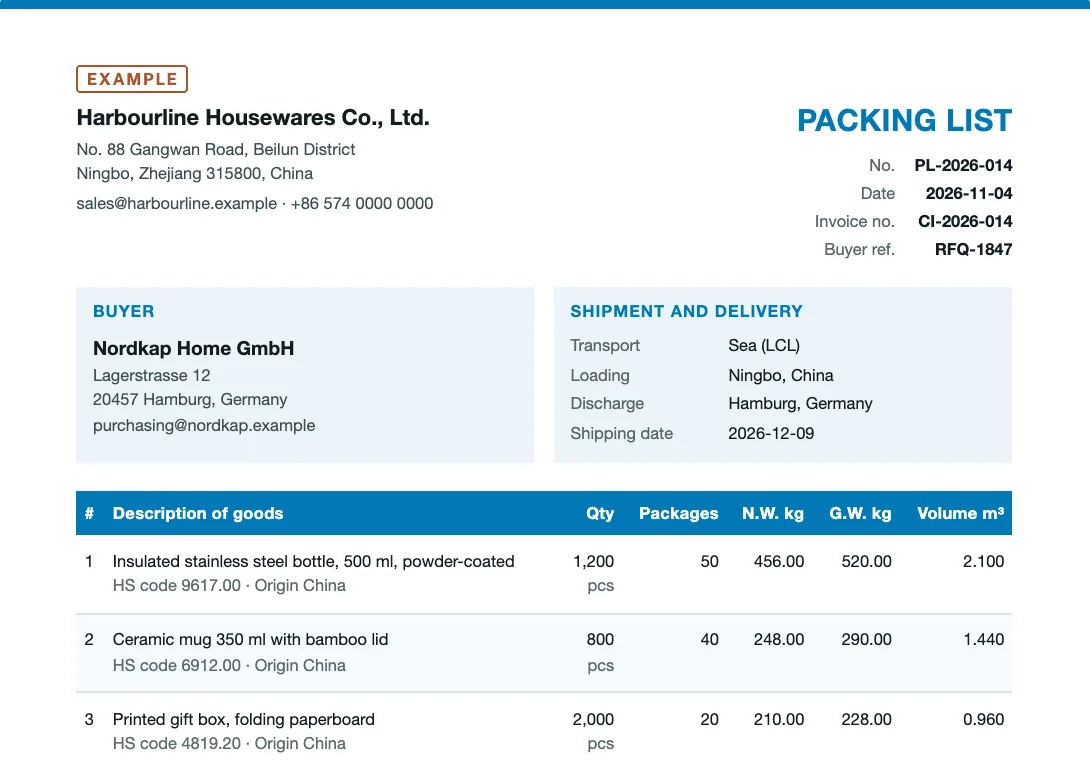
The commercial invoice should show the same cartons and weights. Quotepad's packing list generator uses the same record as the commercial invoice, so nothing is retyped. It shows packages, net and gross weight, volume and shipping marks without prices, as an A4 or US Letter PDF; free, no sign-up, drafts kept in your browser.
Is an HS code required on a packing list?
Not as a general rule, based on the sources checked. ITA's list of typical packing list fields does not include an HS code, and its packing list page does not mention one. The HS code is tied to the commercial invoice instead: ITA says it may be included there and can speed export clearance, and UK export guidance lists it among the invoice contents.
Some importing countries do require it. ITA's guide for the United Arab Emirates asks for a detailed packing list showing weight, method of packing and HS code for each item. Argentina's packing list requirement, by contrast, covers weights, marks and numbers without mentioning HS codes. Because rules vary, ask the buyer or their customs broker. If you add HS codes, use exactly the codes on the commercial invoice.
For the invoice side of the same shipment, see pro forma vs commercial invoice; the Incoterms® 2020 chart and the other guides cover delivery terms.
Frequently asked questions
What is a packing slip?
A document included with an order that lists the items, SKUs and quantities along with the shipping and billing addresses. Warehouse staff use it to pick and pack, and the customer uses it to check what arrived.
Is a packing slip the same as an invoice?
No. Etsy states that packing slips are not considered invoices for buyers, and for gift orders it leaves the price breakdown off the slip. An invoice is the document that bills the buyer.
What is the difference between a bill of lading and a packing slip?
A bill of lading is the contract between the owner of the goods and the carrier; an original is usually needed to take possession. A packing slip is the seller's note of what is in the box.
Is an HS code required on a packing list?
Generally not: ITA's typical packing list fields do not include one. Some countries require it; the United Arab Emirates asks for each item's HS code. Check with the buyer's customs broker, and match the commercial invoice.
Where does an export packing list go?
ITA says it goes inside the carton or package, or is attached to the outside with a copy kept inside.
Can a packing list replace the commercial invoice?
No. ITA states that the packing list is not a substitute for the commercial invoice, and that the commercial invoice should reflect the information on the packing list.
Sources
- U.S. International Trade Administration, "Packing List", trade.gov/packing-list (opened 29 October 2026).
- U.S. International Trade Administration, "Common Export Documents", trade.gov/common-export-documents (opened 29 October 2026).
- U.S. International Trade Administration, "Commercial Invoice", trade.gov/commercial-invoice (opened 29 October 2026).
- U.S. International Trade Administration, "United Arab Emirates - Import Requirements and Documentation", trade.gov/country-commercial-guides/united-arab-emirates-import-requirements-and-documentation (opened 29 October 2026).
- U.S. International Trade Administration, "Argentina - Import Requirements and Documentation", trade.gov/country-commercial-guides/argentina-import-requirements-and-documentation (opened 29 October 2026).
- Legal Information Institute (Cornell), "19 CFR § 141.86 - Contents of invoices and general requirements", law.cornell.edu/cfr/text/19/141.86 (opened 29 October 2026).
- Department for Business and Trade, "How to create a commercial invoice for export", business.gov.uk/export-from-uk/learn/…/how-create-export-invoice (opened 29 October 2026).
- Shopify Help Center, "Packing slips", help.shopify.com/en/manual/fulfillment/managing-orders/printing-orders/packing-slips (opened 29 October 2026).
- Etsy Help, "Packing Slips and Order Receipts for Sellers", help.etsy.com/hc/en-us/articles/115015692187 (opened 29 October 2026).
This guide is general information, not legal or customs advice. Requirements differ by country and change over time; confirm them with your buyer's customs broker before you ship.